
Borrowed Power vs. Real Power
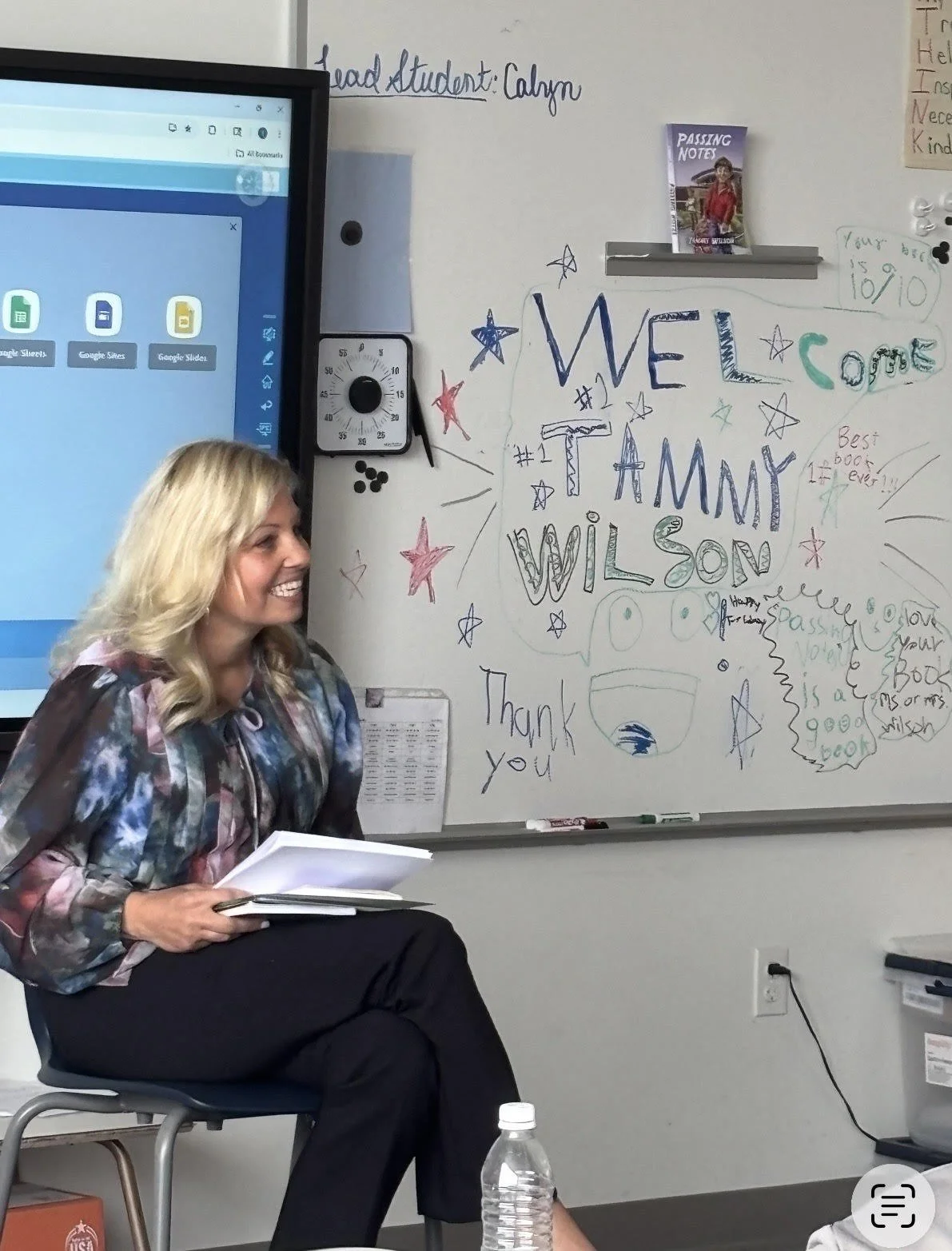
Tammy Wilson leading classroom discussion about kindness and social power.
Reflections from a Fourth Grade Author Visit
There was a moment during a recent fourth grade author visit when the entire room shifted.
At the beginning of our discussion, most students believed Griffin — one of the characters in Passing Notes — had all the power.
In the scene we read together, Griffin was calling Logan names in front of other students. Hands immediately shot into the air.
“Griffin has the power.”
“Logan doesn’t.”
At first glance, they were right.
Griffin had the attention.
The reactions.
The laughter.
The audience.
But then we slowed the scene down and asked a deeper question:
Where was Griffin’s power actually coming from?
That’s when the conversation changed.
The students began noticing something important:
his power depended completely on other people feeding it.
The laughter.
The reactions.
The silence from students who didn’t want attention turned onto themselves.
And suddenly the students saw it differently.
Griffin’s power wasn’t truly his.
It was borrowed.
Borrowed from fear.
Borrowed from audience reactions.
Borrowed from the discomfort of bystanders who didn’t know how to interrupt the moment.
And the students quickly realized something else:
The moment people stop feeding borrowed power, it begins to shrink.
That discussion led us to two other characters in the story:
Logan and Gabe.
Logan never needed to humiliate someone else to matter. Even while being targeted, his value did not depend on controlling the room or gaining attention.
And then there was Gabe.
The student who quietly sat beside Logan when he was the new kid.
The student who chose courage when it would have been easier to stay silent.
By the end of the visit, we had created a phrase for that kind of courage:
“Be a Gabe.”
Not the loudest person in the room.
Not the most intimidating.
Not the person getting the reactions.
The person who notices people.
The person who quietly changes the feeling of a room.
The person who makes others feel safe.
One of the most powerful parts of the discussion centered around bystanders and upstanders. The students spoke honestly about something adults often forget:
Sometimes students laugh along not because they think something is funny, but because they are afraid of becoming the next target.
That honesty mattered.
Because understanding bullying requires understanding audience dynamics, social pressure, belonging, fear, and courage.
At one point during the visit, a teacher asked me to repeat the following:
“Fear gets attention fast. But character lasts longer.”
Honestly, I don’t think I’ll forget that moment for a very long time.
What gave me hope that day was not perfection.
It was awareness.
Fourth graders are capable of incredibly thoughtful conversations when we create space for them.
They understand more than we think:
about loneliness,
about pressure,
about belonging,
about the courage it takes to stand beside someone when it would be easier not to.
And maybe that’s the real lesson students taught me during this visit:
Borrowed power may look big for a moment.
But real power changes people.